Vectorized Query Execution in PostgreSQL 19: Arrow, ORCA and Flight SQL in a PostgreSQL Extension
Last week I ported Apache Cloudberry to PostgreSQL 19 as a set of extensions and described where the port falls behind the original fork. On ClickBench, columnar engines beat it by an order of magnitude. The culprit isn’t the MPP implementation but PostgreSQL’s executor, which works on rows. Each row travels up the node tree on its own, every value goes through fmgr, and the cluster’s segments merely add more processors running the very same loop over table rows.
The logical next step is a vectorized executor. Apache Cloudberry’s open-source code doesn’t have one: only traces of the closed-source engine remain in the repository, namely the create_vectorization_plan flag, which the open-source planner always passes as false, a WindowHashAgg node with no executor behind it, and a PAX adapter under VEC_BUILD that hasn’t compiled for a long time. I would have to design it myself and, of course, as an extension once again.
That is how pg_vexec came about, a family of extensions for PostgreSQL 19:
vexec: a vectorized planner and executor in one module;vexec_flight: an Arrow Flight SQL endpoint that serves and accepts Arrow while the vectorized executor is on;vexec_pgvectorandvexec_postgis: kernel packs that let pgvector’s and PostGIS’s functions compute over batches.
The project doesn’t require modifying PostgreSQL, even with the ORCA planner. The gp_orca module from the Cloudberry port now builds on its own, without gp_core and without core patches, and vexec turns ORCA into a vectorized engine: ORCA’s search weighs its alternatives with the costs of vector nodes, and its translator builds those nodes directly. Core patches are needed only if Cloudberry itself is loaded into the server. Then vexec can also read the columnar PAX and ao_column tables column by column and write to them the same way, without turning the data into rows, and between segments the Motions carry data as Arrow IPC frames.
Once again Claude Code wrote the code for me, in parallel sessions, each in its own git worktree, while I set the tasks, made the architectural decisions and checked the results. I started on the plan for a vectorized PostgreSQL extension on October 2, the code started on October 5, and by the morning of October 7 thirteen iterations had been built, from the first ClickBench run for the baseline to sending columnar data as Arrow from the database’s memory between servers through Motions.
It started with DataFusion
It all began a month and a half ago with the idea of embedding a ready-made vectorized engine, Apache DataFusion, in PostgreSQL. This had already been done in open source before me, but I wanted the new solution to be distributed and faster. In the plan for pg_arrow, a Rust core was to sit behind a C ABI, with everything that touches PostgreSQL’s headers kept in a thin C layer. DataFusion would live in a single background worker per cluster, with its own Tokio thread pools. A backend would offer the planner ArrowScan CustomPaths through the path hooks, translate the chosen subtree from PlannerInfo into a DataFusion logical plan and send it to the service. Producer processes would encode heap rows into Arrow pages in shared memory, results would come back as pages in PostgreSQL’s layout, Flight SQL would serve Arrow to the outside world straight from the service, and columnar tables would be stored in Iceberg on object storage.
The more closely I worked through this plan with the agents, the longer the list of compromises grew. DataFusion’s semantics aren’t PostgreSQL’s: collations, numeric scale, the ordering of NaN, time zones, and even now(), which DataFusion pins when it hands out a session state, so two statements of one transaction would see different times. jsonb and geometries would travel between processes as text and EWKB and be rebuilt on every row, and every data path added a copy: heap into Arrow pages, results back into PostgreSQL pages. The service would be a child of the postmaster, so an abort, a potential segfault in zstd or a visit from the OOM killer would restart the whole cluster. DataFusion 55.1’s hash join couldn’t spill to disk, datafusion-proto silently dropped plan fields, and until SubPlans, InitPlans, CTEs, partitions and eager aggregation were translated, such queries would stay on PostgreSQL’s plan.
And the gain was questionable: the fastest parts of such an engine, vectorized scans, filters and aggregates, can be had inside the backend too, with PostgreSQL’s semantics and without copies between processes. So pg_arrow remained a plan without a single line of code. When my port of Cloudberry to extensions gave me ORCA, PAX and gp_ao as modules, I came up with a plan for vectorizing query execution: not one more engine next to PostgreSQL, but a vectorized executor inside the PostgreSQL DBMS itself. It kept several things from pg_arrow: the mapping table for Arrow types, pages in PostgreSQL’s layout as the prototype of the postgres format, the corpus of function semantics, Flight SQL logins through pg_hba.conf, and even the definition of done for Flight SQL, which is that TPC-H Q1 through it must be faster than binary COPY.
So, as in the refactorings of legacy systems at my previous jobs, I decided to clean out the Augean stables starting from the main dependency, the planner. I chose ORCA for that role and began preparing PostgreSQL for the idea: vectorized execution, and data transfer over Flight SQL in addition to pgwire.
Why an extension?
Vectorizing PostgreSQL isn’t a new idea, and every way of doing it has had its price. openGauss built a vectorized executor of about 82,000 lines into a fork of PostgreSQL 9.2 that can no longer be merged with upstream. pg_duckdb hands the query to a second engine, DuckDB, right inside the backend, and it raises the same questions about semantics that pg_arrow did. And openGauss, vectorize_engine, Hydra and TimescaleDB’s VectorAgg insert vector nodes into a finished plan, so vectorization never competes on cost. In TimescaleDB this approach has led to wrong results (#9902, for example) and crashes.
I gave the agents the same conditions as for the Cloudberry port: “plug the executor in only through PostgreSQL’s existing hooks, and without the extension loaded the server must behave like vanilla.” Six research reports checked every boundary of the design against the code, from planning to the cluster, and not one of them needed a new hook. Hence the rules for every phase:
- no core changes. On the whole, I got lucky! The vendors who built vectorized executors for PostgreSQL apparently got all the extension points and hooks this takes into the upstream core, except for vectorized reading and writing of data in the table AM. The core had all the extension points needed;
- vector execution nodes are available to the planner and compete with row-based alternatives on cost. Nobody rewrites a finished plan;
- one model for both planners: one capability oracle, one cost model in PostgreSQL’s units, one set of node builders;
- PostgreSQL’s semantics down to the last SQLSTATE: NULLs, unevaluated CASE branches, collations, NaN, the order of float summation. A kernel only speeds things up, and completeness comes from the fallback to PostgreSQL’s expression evaluator;
- Cloudberry’s sources (other than
pg19/) don’t change, and no code is copied from openGauss, Hydra or TimescaleDB; - the backend stays single-threaded and in C: palloc within
work_mem, spills to BufFile, errors throughereport.
The extension’s vanilla behaviour is checked at every step of implementation, and checked hard, as in my Cloudberry port. PostgreSQL’s 239 regression tests pass against unchanged expected files with vexec installed, preloaded with mode off, and in explain mode. A differential runner compares the answers of force sessions in the postgres format, in the arrow format and with random column layouts against off, and every difference, such as plans that the tests print themselves, has been examined and recorded. My Cloudberry port’s suites likewise compare force with off, and the 121 TPC-H and TPC-DS queries are checked against DuckDB’s answers. And if a plan with a vector node reaches a segment where the library has been removed, the segment answers with a clean error, ExtensibleNodeMethods "VecScan" was not registered, and the cluster stays up.
Architecture: what this does better than plain PostgreSQL and Cloudberry
PostgreSQL and Cloudberry execute a query the same way, row by row. vexec replaces the rows in memory with a buffer of up to 1,024 rows laid out by column: that many rows of a fragment fit in the L1/L2 caches while they are being filtered, projected and aggregated. But the in-memory columnar structure itself is less interesting than where vector queries over this data are planned, and how data gets into this structure and out of it.
| PostgreSQL 19 | Cloudberry without vexec | pg_vexec on vanilla PostgreSQL 19 | pg_vexec in the Cloudberry port | |
|---|---|---|---|---|
| Unit of execution | a row | a row: the open-source code has no vectorized executor | a batch of up to 1,024 rows by column; kernels by function OID, fallback inside the same node | the same, on the coordinator and every segment |
| Who decides what to vectorize | - | judging by PAX’s tests, the closed-source engine converts a finished plan node for node, with the row plan’s costs | both planners, by cost: PostgreSQL’s path hooks, and ORCA | ORCA, costing vector nodes, for MPP plans; PostgreSQL’s planner on the segments |
| Table reads | heap through slots | AOCO and PAX return slots | heap page by page, with batched MVCC checks; other AMs through slots | PAX and ao_column return batches; aggregates from PAX’s statistics |
| Inserts | ModifyTable row by row; multi_insert only in COPY FROM |
the same; PAX and gp_ao split rows into columns themselves | VecInsert; into heap 1,000 rows at a time through table_multi_insert |
VecInsert writes columns into PAX and ao_column without rows |
| Between processes | Gather: a MinimalTuple per row | Motion: a MinimalTuple per row and an fmgr hash of the key per row | as in PostgreSQL | Arrow IPC frames, vectorized cdbhash, shared memory for segments on one host |
| Arrow for clients | no: ADBC assembles Arrow from binary COPY | no | Flight SQL: results served from batches, inserts into VecInsert | the same, on the coordinator |
| PostGIS and pgvector functions | row by row | row by row | a batch’s rows at a time through fmgr, by the packs’ declarations | the same, on the segments |
| Core changes | - | a fork; the port has 24 hook patches | none | only those the port itself needs |
Now in order, starting with what it is all built from.
Components
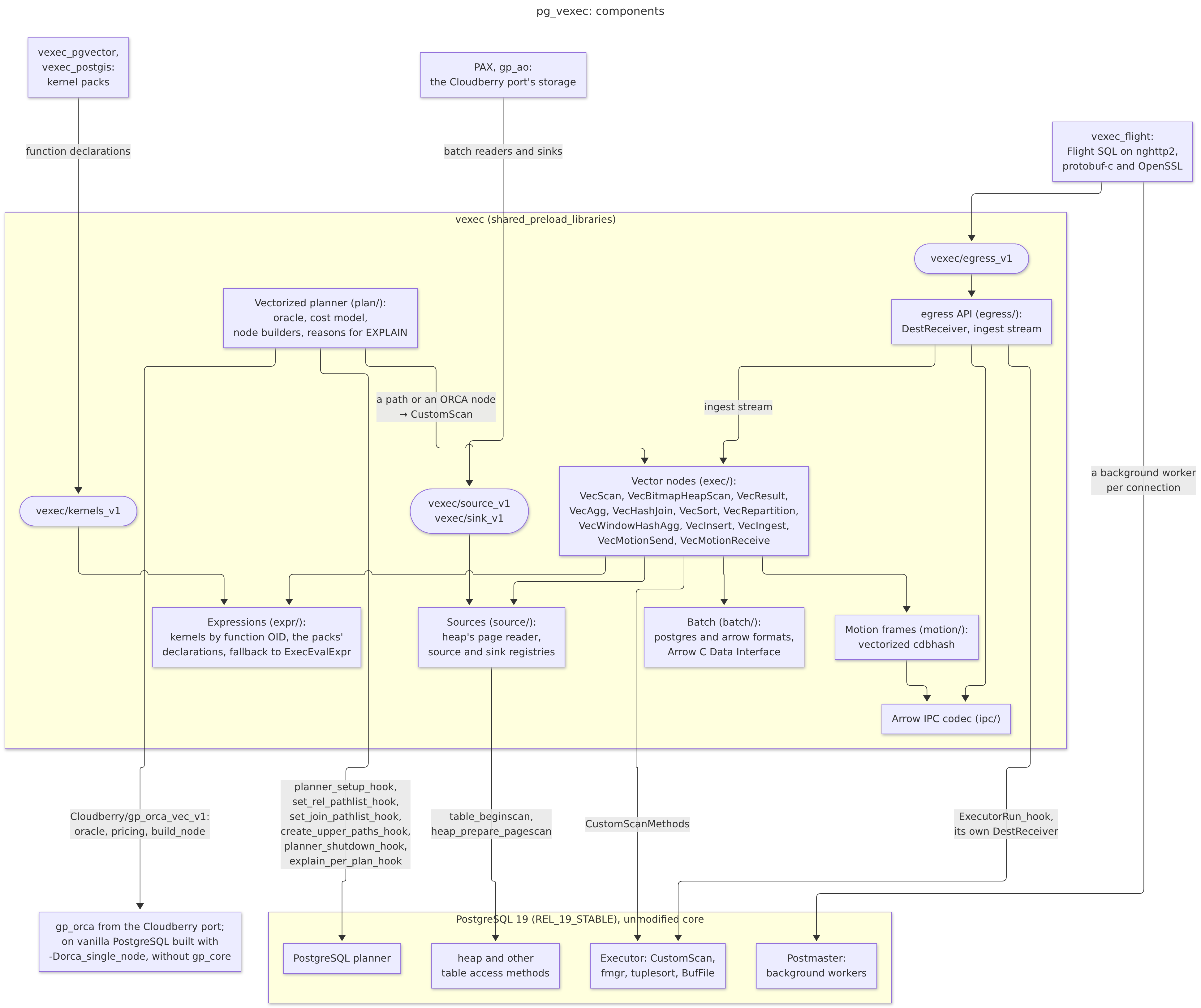
vexec is a single module in shared_preload_libraries, built with PGXS both for vanilla PostgreSQL 19 and for the Cloudberry extension port. The vectorized planner (plan/) is built into both planners and decides which operators become vector nodes. The executor is a set of CustomScan nodes (exec/) on top of a shared batch layer (batch/) and an expression compiler (expr/). Alongside them live the Arrow IPC codec (ipc/), the egress API for Flight SQL (egress/) and the Motion frames (motion/).
External links go through PostgreSQL’s rendezvous variables, with the major version in their names, the same way the port’s modules find gp_core’s API. Storage modules register batch readers in vexec/source_v1 and sinks in vexec/sink_v1, vexec_flight finds vexec/egress_v1, the kernel packs find vexec/kernels_v1, and vexec itself finds ORCA through Cloudberry/gp_orca_vec_v1. The order of the modules in shared_preload_libraries doesn’t matter, and without the library loaded, a variable stays an empty entry in the server’s memory and nothing is registered.
A vectorized planner inside the database, not next to it
In PostgreSQL’s planner, vexec adds paths through the planner’s own hooks: VecScan in set_rel_pathlist_hook, just as Citus’s columnar storage adds its scan, VecHashJoin in set_join_pathlist_hook, and VecAgg and VecSort in create_upper_paths_hook. From there they compete with row paths in the ordinary add_path. A vector path’s cost is derived from the row path’s, with multipliers for the kernels’ work, a columnar source estimates only the bytes of the columns it needs, and the transitions between rows and batches are chosen by cost. The strategy masks are honoured as well, so enable_seqscan = off and pg_hint_plan’s hints apply to vector paths too. PostgreSQL calls no hook for partial aggregation, so vexec builds the pair of partial and final VecAggs around a Gather itself:
SET vexec.mode = force;
EXPLAIN (COSTS OFF)
SELECT hw.k, count(*), sum(hp.b) FROM hp JOIN hw ON hp.id = hw.id GROUP BY hw.k;
 Vec Finalize HashAggregate
   Group Key: k
   ->  Gather
         Workers Planned: 3
         ->  Vec Partial HashAggregate
               Group Key: k
               ->  Vec Hash Join
                     Hash Cond: (hp.id = hw.id)
                     ->  Parallel Vec Seq Scan on hp
                     ->  Vec Seq Scan on hw
The path hooks can’t reach ORCA’s plans: ORCA builds its own PlannerInfo and returns a finished plan. So the port uses a small API in gp_orca, through which vexec registers its oracle, its cost estimates and its node builders:
CCostModelVec, a subclass ofCCostModelGPDB, evaluates ORCA’s formulas twice, as they are and with vector multipliers, and blends the two by the share of steps that go to kernels. ORCA thus chooses join orders, aggregation stages and Motions with vectorized execution already in the cost;- the translator offers vexec every finished node, and vexec replaces it with a vector node if the oracle agrees, before the Motions are checked, the slice table is made and M8’s passes run, so every later step of the Cloudberry port sees the final tree;
- ORCA’s hashed window aggregation, which PostgreSQL 19 has nothing to execute with, becomes a
VecWindowHashAggunder an ordinaryWindowAgg.
In vexec.mode = explain, vexec costs the vector alternatives but doesn’t choose them, and EXPLAIN (VEXEC) explains what was considered and why it wasn’t taken:
SET vexec.mode = explain;
EXPLAIN (VEXEC, COSTS OFF)
SELECT b, count(*), sum(d) FROM vt WHERE a > 10 GROUP BY b ORDER BY b;
 Sort
   Sort Key: b
   ->  HashAggregate
         Group Key: b
         ->  Seq Scan on vt
               Filter: (a > 10)
 Vexec: mode explain, format postgres
   VecScan on vt: not chosen (explain mode)
     source: heap's pages; quals: 1 kernel step, 0 fallback steps; target: 0 kernel steps, 0 fallback steps
   VecAgg on GROUP BY: not chosen (explain mode)
     hashed, 1 grouping column, 2 aggregates, 2 with vector transitions (count(*), numeric sum)
   VecSort on ORDER BY: not chosen (explain mode)
     1 sort key
Planning doesn’t get any more expensive: EXPLAIN of all 121 TPC queries on four segments under ORCA took 9,715 ms without vexec and 9,696 ms with it, and under PostgreSQL’s planner 161 and 166 ms.
In phase V6 I brought ORCA to vanilla PostgreSQL 19. The -Dorca_single_node build replaces gp_core with a stub of about 400 lines: it answers calls to gp_core’s API, and to the 14 of its functions that ORCA calls on a single node, the way gp_core would answer on a server without segments. With ORCA on vanilla REL_19_STABLE, all 239 regression tests pass, 27 of them with examined differences, and the 121 TPC queries in force mode answer the way DuckDB does. Of the 652 hash joins in their plans, 651 became VecHashJoin: all but a full join, which VecHashJoin can’t do yet.
Two in-memory data formats
The batch format is chosen by a setting; that was my requirement. vexec.batch_format = postgres, the default, stores values the way PostgreSQL defines them, and arrow stores them in standard Arrow types:
| Type | postgres format | arrow format |
|---|---|---|
| bool | a byte per value | a bit per value |
| date, timestamp | PostgreSQL’s epoch, 2000-01-01 | the Unix epoch |
| interval | PostgreSQL’s 16 bytes | month_day_nano |
| text, bytea | a Datum per value, with the varlena header | utf8_view or binary_view |
| int, float, uuid, numeric with a typmod of up to 38 digits | the same in both formats: values at the type’s width, numeric as scaled int64 or int128 |
PostgreSQL’s own boundaries cost the postgres format nothing: fmgr, slots, tuplesort, hash functions, and the heap, ao_column and porc storage. Arrow’s boundaries cost the arrow format nothing: export, Flight SQL, porc_vec and frames between processes. Conversions happen only at these named boundaries, and the cost model accounts for their price. The validity bitmap is shared by both: it has the same polarity and bit order as the NULL bitmap of a heap tuple. Kernels are generated for each layout, and four settings change the layout separately for strings, bool, dates and numeric. On ClickBench the two formats differed by no more than 2.6%.
The scaled numeric was borrowed from openGauss as an idea but written from scratch to PostgreSQL’s numeric rules, and the gain on TPC-H Q1 is almost entirely its doing: with the varlena layout Q1 got 2–9% faster, with the scaled numeric 1.8–2.8× faster. The epochs have an edge case, though: the timestamp 294247-01-10 04:00:54.775807, shifted to the Unix epoch, gives exactly the int64 maximum, which PostgreSQL uses for +infinity, so a batch holding that timestamp keeps its column in PostgreSQL’s epoch.
Columnar data structures from storage
The source contract answers the question “why would the table AM need new hooks at all?” A storage module publishes begin, next, rescan, end and estimate functions through a rendezvous variable, and the scan is opened by the ordinary table_beginscan, so the snapshot, predicate locks, parallel scan ranges, MVCC, pruning and deletes all stay with the access method. A deleted row goes into the selection bitmap, not into validity; otherwise count(*) would count it.
- heap is read by vexec itself, page by page, through
heap_prepare_pagescan, the way TABLESAMPLE does it: page pruning, locking, PostgreSQL 19’s batched visibility checkHeapTupleSatisfiesMVCCBatch, and the needed columns deformed straight into the batch. vexec doesn’t decide visibility with code of its own: in the port the snapshot is distributed. - PAX returns groups of up to 131,072 rows, sliced into batches without copying, and porc_vec stores almost Arrow’s layout. For
aggregate(),count,min,max,sumandavgwithout conditions are taken straight from the files’ and groups’ statistics, andcount(*)over 10 million rows takes 0.33 ms instead of 265. And throughset_keys(), aVecSortwith a LIMIT passes the scan a “running bound”, so PAX skips groups that can no longer make it into the answer. - ao_column returns blocks of up to 16,384 rows: a fixed-width column without NULLs becomes a slice of the decompressed buffer, and a varlena column becomes Datums pointing into it.
Inserts mirror this. VecInsert takes the place of ModifyTable’s loop and writes a batch into the storage’s sink or, where there is none, through table_multi_insert 1,000 rows at a time, as COPY does. NOT NULL is checked against validity, and the first row that fails the check goes to ExecConstraints() so that the error is the same. Partitions are chosen by PostgreSQL’s functions, indexes get their entries through ExecInsertIndexTuples(), and once again the core didn’t need touching: COPY FROM inserts without ModifyTable too. On a cluster, ModifyTable stays on the coordinator, because gp_core dispatches the write through it, and VecInsert works under it on the segments. Triggers, foreign keys, ON CONFLICT, RETURNING and WITH CHECK keep the ordinary ModifyTable, and EXPLAIN names the reason.
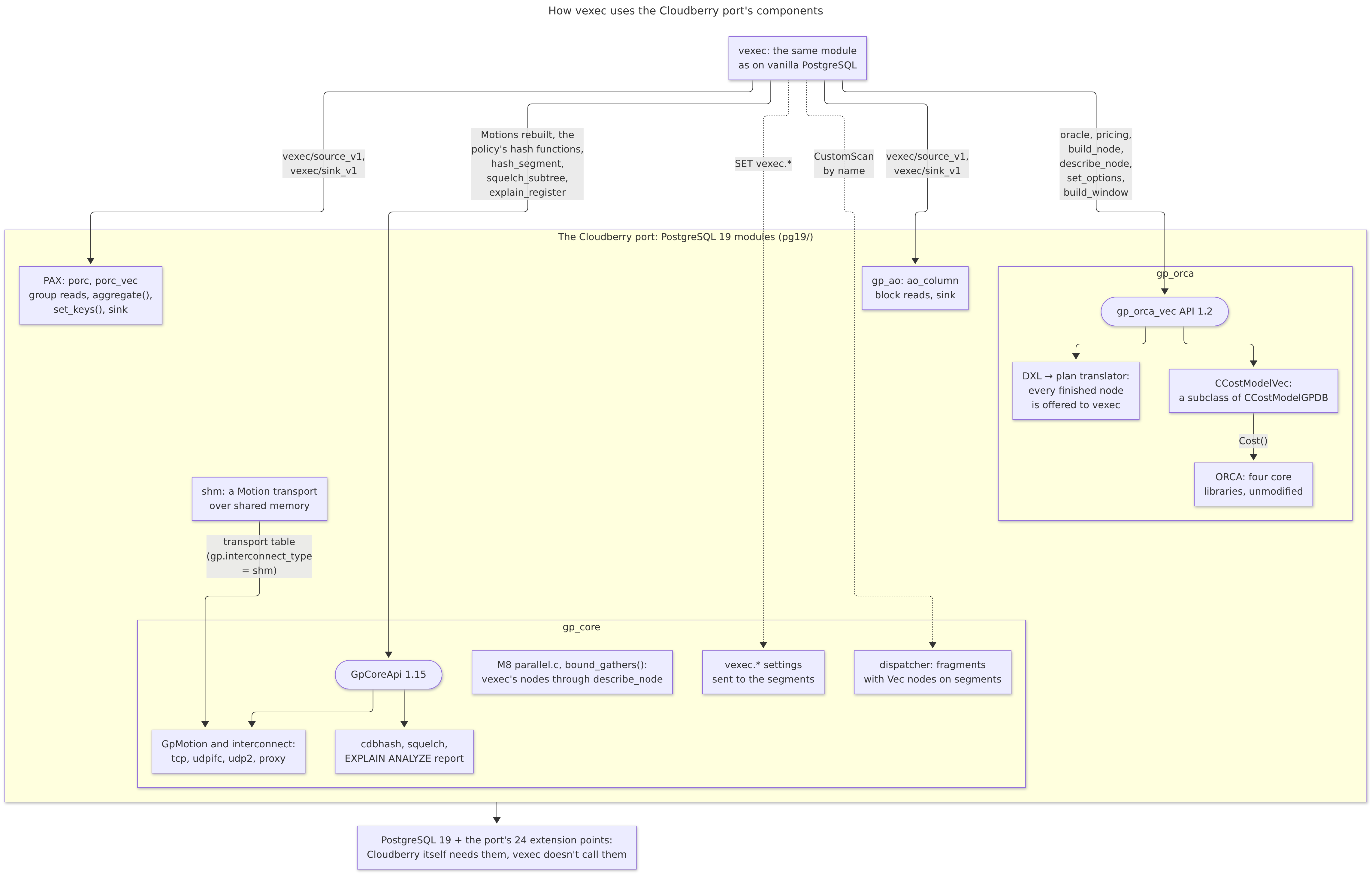
Everything vexec required of my Cloudberry port is module code in pg19/: gp_orca’s API and CCostModelVec, the entry points of GpCoreApi 1.15, the vexec.* names in the list of settings that the coordinator sends to the segments, PAX’s and gp_ao’s batch readers and sinks, and shm, the transport within one host. ORCA’s four core libraries compile from the Cloudberry tree unmodified. vexec doesn’t call the port’s core patches: it may use them indirectly, but only the ones PAX and gp_ao use, plus the memory hook, which counts its batches in resource groups like any module’s memory.
Arrow IPC through Motions
Between segments, Cloudberry sends rows: for every row a Motion forms a MinimalTuple and calls the key’s hash function through fmgr, and rows go to the coordinator through libpq with a send and a receive for every value. If there are vector nodes on both sides of a Motion, a batch is taken apart into rows only to be put back together again.
I asked whether the distribution keys could be read straight from Arrow buffers, and batches passed between nodes over Arrow Flight SQL. The first is done, the second isn’t: Flight would bring C++, gRPC and threads into the backends; flow control, the receiver’s STOP and the statement token, all of which the Cloudberry port’s interconnect already has, would have to be built again; and it would copy no less. So a batch travels over the port’s transports as an Arrow IPC frame, and the Motion code itself doesn’t change:
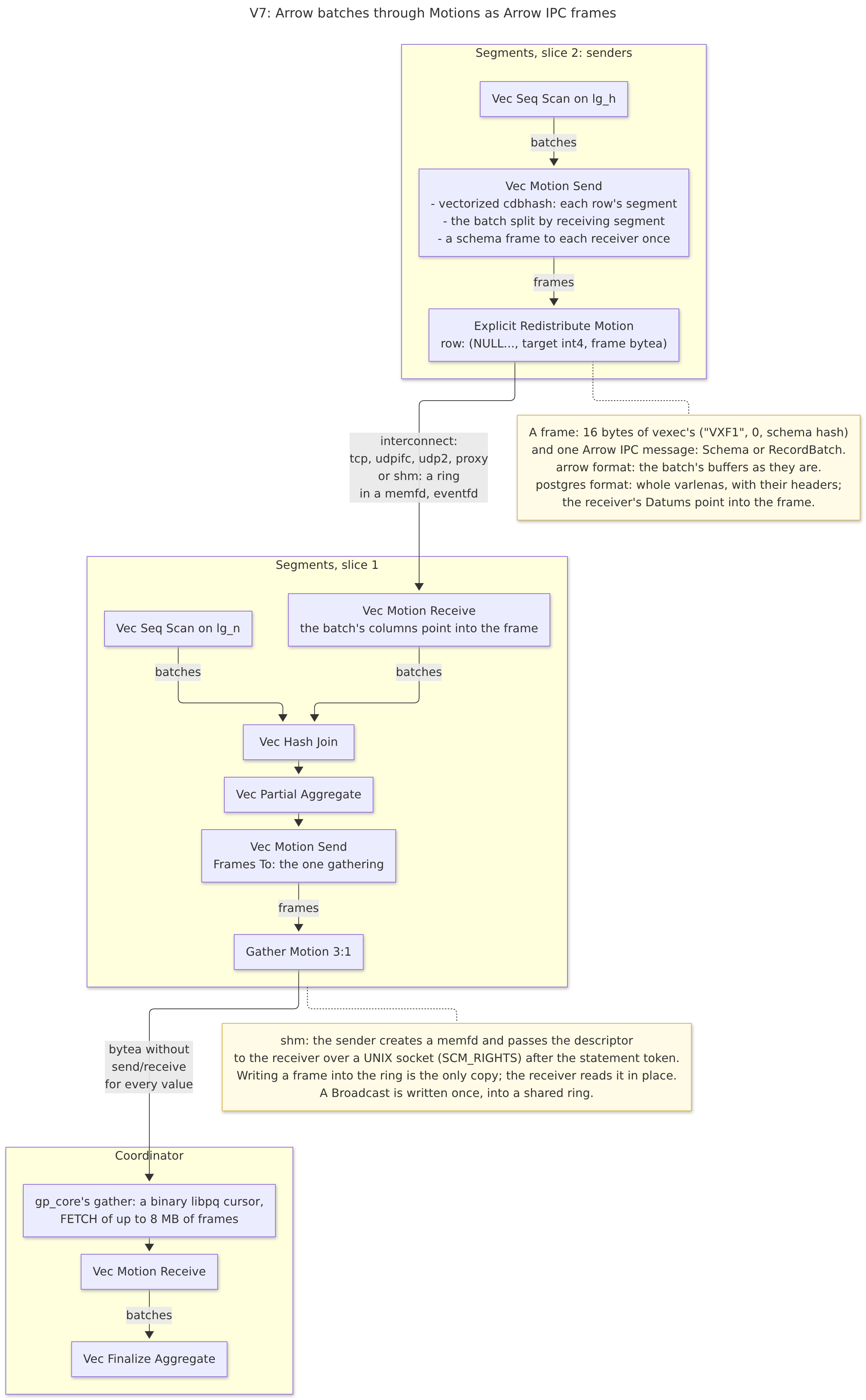
- When the translator offers vexec a Motion whose sending fragment has a vector node at its top, vexec puts a
VecMotionSendunder it and aVecMotionReceiveover it, and rebuilds the Motion itself in the same place through gp_core’s setters: a Redistribute becomes an Explicit Redistribute by segment number. A row of such a Motion is the fragment’s columns, all NULL, the segment number and the frame as a bytea. - A frame is 16 bytes of vexec’s own (
VXF1, a reserved field, the schema hash) followed by an Arrow IPC message from V7_0’s codec. In the arrow format the buffers go out as they are; in the postgres format a varlena is written whole, and the receiver’s Datums point straight into the frame. The schema goes to each receiver once and is kept there by its hash, since the frames of all the senders arrive interleaved. - The vectorized cdbhash reproduces
GpHashSegmentbit for bit, otherwise rows would go to the wrong segments: kernels for integers, float, text, uuid and dates,hash_numericreproduced from the scaled integer, and a row-by-row path through gp_core for legacy keys. - A
VecHashJointhat no longer needs its side with a Motion stops that side’s senders throughsquelch_subtree(), and the vector nodes’ counters come back from the segments into EXPLAIN ANALYZE. - Frames go to the coordinator through the same binary libpq cursor, without a send and a receive for every value.
For segments on one host, the port gained the shm transport: the sender creates an anonymous file with memfd_create, passes the descriptor to the receiver through SCM_RIGHTS after the statement token and writes frames into a ring, and the receiver reads them in place, so writing into the ring is the only copy. Both sides sleep on an eventfd in their WaitEventSet, so cancellation and timeouts work as they do over tcp, and the anonymous mapping disappears along with the last process, even one that crashed. Between hosts, a slice goes over tcp.
Both switches take effect from the next statement: vexec.enable_motion_frames is read at planning time and calls ResetPlanCache() when its value changes, so prepared statements and PL/pgSQL are planned again, and the transport is chosen by gp.interconnect_type. A sorted Gather, which merges rows, a write’s Motion and a Motion over a row node are not framed. Here is a plan from a test cluster of three segments:
 Vec Finalize Aggregate
   ->  Vec Motion Receive
         ->  Gather Motion 3:1  (slice1; segments: 3)
               ->  Vec Motion Send
                     Frames To: the one gathering
                     ->  Vec Partial Aggregate
                           ->  Vec Hash Join
                                 Hash Cond: (h.n2 = x.n)
                                 ->  Vec Motion Receive
                                       ->  Explicit Redistribute Motion 3:3  (slice2; segments: 3)
                                             ->  Vec Motion Send
                                                   Frames To: the segments their keys hash to
                                                   Hash Key: n2
                                                   ->  Vec Seq Scan on lg_h h
                                 ->  Vec Seq Scan on lg_n x
 Optimizer: GPORCA
The cluster tests pass both over tcp and under shm, where all 2,777 senders and 2,777 receivers went through rings, and after a receiver is terminated, neither a mapping nor a file in /dev/shm is left behind. On wide rows of 1.8 KB, shm came out faster: about 80 ms against 93 over tcp.
Arrow both in the database’s memory and on the wire with Flight SQL
Today, Arrow clients read PostgreSQL through ADBC and binary COPY: the server sends rows, and the driver assembles columns from them. vexec_flight serves Arrow straight from batches, and only while the vectorized executor is on: the acceptor starts only if vexec_flight.listen_addresses is set and vexec is loaded, with vexec.mode = off a statement gets FAILED_PRECONDITION, and the extension has no row path to the client at all.
For BI and ML, Flight SQL is more than just another transport. Over pgwire a result travels as rows: every value goes through its type’s send function or is turned into text, a driver such as psycopg or JDBC assembles rows, and then pandas, Polars or DuckDB lay them out by column all over again. Over Flight SQL the client receives Arrow record batches, the very layout these libraries keep their data in anyway: pyarrow hands over a fixed-width column without NULLs as a NumPy array without copying. The schema with its types arrives before the first row, decimals with their precision and scale, timestamptz as UTC time, so a BI tool doesn’t have to guess types from text. The drivers are standard ones: ADBC Flight SQL for Python, Go, Java and C, and Flight SQL JDBC for anything that takes a JDBC driver. The way back is columnar too: adbc_ingest() writes a DataFrame straight into a table through VecInsert. Flight served a million lineitem rows 4.7× faster than binary COPY. Flight SQL only complements PostgreSQL’s familiar pgwire clients; it doesn’t replace them.
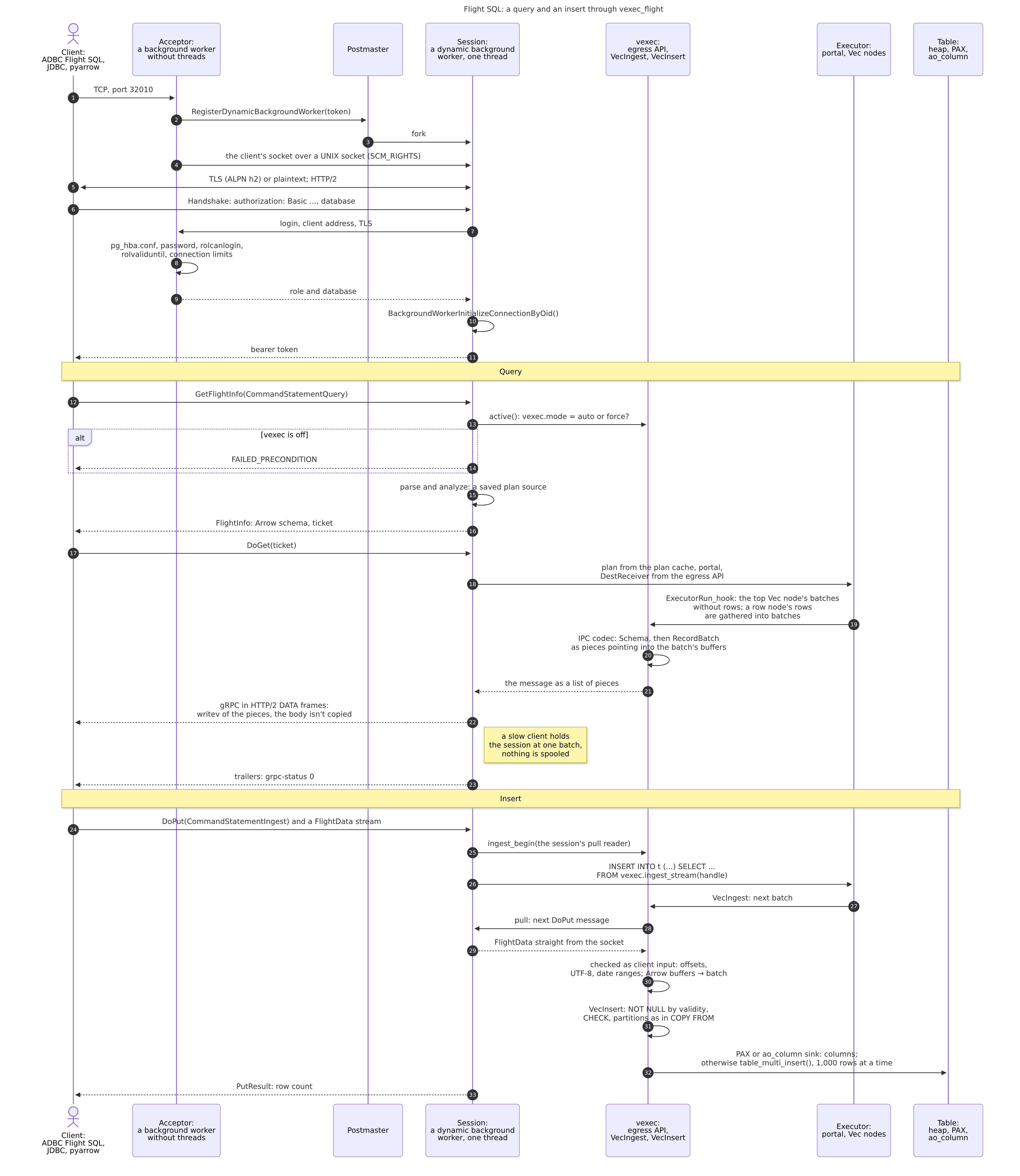
The process model here is PostgreSQL’s, not a service with threads: an acceptor without threads asks the postmaster to start a dynamic background worker for each connection and hands it the socket through SCM_RIGHTS. The session itself runs TLS, HTTP/2 on nghttp2 and gRPC, and waits on its socket and its latch the way a backend does, so pg_cancel_backend() and CancelFlightInfo work on it. A login is checked against pg_hba.conf with the client’s real address, the role’s password and the connection limits, and statements run through portals, so hooks, privileges, RLS, transactions and pg_stat_statements behave as they do over PostgreSQL’s usual protocol.
The result is written by vexec’s DestReceiver. If there is a vector node at the top of the plan, the ExecutorRun hook hands over its batches without a single row, and the columns whose layout matches their Arrow type go to the socket in one writev straight from the batch’s buffers. A slow client simply slows the session down: while a 20 GB result was read at a leisurely pace, the session’s memory grew by less than a megabyte.
Inserts take the reverse path. CommandStatementIngest becomes INSERT INTO t ... SELECT ... FROM vexec.ingest_stream(handle), and VecIngest takes the next DoPut message from the socket only when the statement needs the next batch. The client’s Arrow is checked as input (offsets, UTF-8, date ranges, decimal precision), and where a column’s type matches the Arrow type, the message’s buffers become the buffers of the batch that VecInsert hands to the PAX or ao_column sink.
PostGIS and pgvector functions
vexec calls other extensions’ functions through fmgr row by row, inside a vector node. But pgvector doesn’t mark its functions leakproof, and PostGIS marks only its btree comparisons and geometry_hash, so a condition with a distance or ST_Intersects became lazy as a whole. A kernel pack doesn’t rewrite functions or introduce an ABI: on top of fmgr and PostgreSQL’s soft errors, it declares which functions may be called, and on which rows, earlier than PostgreSQL would call them:
- never raises: the function is called on the batch’s active rows; these are PostGIS’s twelve 2-D box operators and
ST_SRID; - check: the function is called where the pack’s check passes, and PostgreSQL evaluates the remaining rows itself, with its own error; these are pgvector’s distances when the dimensions are equal, and
ST_XandST_Yfor a point; - prefilter: the pack’s answer is taken where it has one, and an undecided row (a soft error from
ereturn) goes to the function itself; these are eleven PostGIS predicates, by their boxes.
A declaration is bound by the extension, its version, and the function’s signature and C symbol, and it is dropped on ALTER EXTENSION UPDATE. vexec_postgis reads the geometry format with its own code, written from gserialized.txt, without a single line of PostGIS. pgvector’s tests (14) and PostGIS’s core tests (143) give the same answers with vexec as without it, and a server without a pack evaluates the same calls row by row: slower, but correctly.
Implementation caveats
- Inherited from PostgreSQL 19:
- Gather and Gather Merge stay row-based: the tuple queue carries one MinimalTuple per row;
ExecSetTupleBounddoesn’t reach CustomScan, soVecSortgets its LIMIT bound at planning time;- there are no vector nodes under UPDATE, DELETE, MERGE, LockRows or
WHERE CURRENT OFcursors: EvalPlanQual re-reads a row into the scan node’s slot, and for heap that has to be a buffer slot.
- Compared with Cloudberry:
- on vanilla PostgreSQL, ORCA’s plans are serial: its parallelism is switched on by gp_core’s
gp.enable_parallelsetting; - a sorted Gather Motion doesn’t carry frames; it merges rows;
- PAX has no
index_delete_tuples, so after an aborted insert into a table with a btree index the next insert may fail, exactly as it does through ModifyTable.
- on vanilla PostgreSQL, ORCA’s plans are serial: its parallelism is switched on by gp_core’s
- Vector-specific:
COUNT(DISTINCT)grouped by strings is 3.1–3.6× slower under PostgreSQL’s planner in auto mode: the cost model prices a serial vector plan below a parallel row plan;- text columns come out of a heap scan more slowly than out of a row scan;
- force gives up index paths, except for nearest-neighbour search, so on a table with a primary key auto is faster than force.
Measurements
All the figures come from Docker images built from committed branches, on my 16-core Ryzen 9 9955HX3D with 60 GB of memory, without assertions, and every answer was checked against DuckDB’s.
ClickBench was run by its own protocol on vanilla PostgreSQL 19 with ORCA, but on 10 million rows, so these figures can’t be compared with the published results on 100 million. The geometric mean of the hot-run timings of the 43 queries, in ms:
| Configuration | heap | heap with a primary key |
|---|---|---|
| PostgreSQL’s planner | 625 | 402 |
| PostgreSQL’s planner + vexec, auto | 506 | 311 |
| PostgreSQL’s planner + vexec, force | 498 | 365 |
| ORCA | 1,647 | 924 |
| ORCA + vexec, auto | 1,349 | 745 |
vexec takes 19–24% off PostgreSQL’s planner in auto mode and 16–19% off ORCA, and the best queries get 8.8–9.5× faster: Q15 and Q16 under PostgreSQL’s planner, Q29 under ORCA. Under PostgreSQL’s planner, Q10, Q11 and Q13 with COUNT(DISTINCT) got slower; under ORCA, Q25 and Q39, where the scan returns text columns. ORCA trails PostgreSQL’s planner by 2.3–2.6×, above all because of its serial plans.
Flight SQL, TPC-H Q1 at SF1, the median of five runs from execute to an Arrow table in the client:
| vanilla PostgreSQL 19 | the port’s coordinator, 2 segments | |
|---|---|---|
adbc_driver_postgresql, vexec off |
0.743 s | 1.115 s |
adbc_driver_postgresql, vexec auto |
0.400 s | 0.567 s |
adbc_driver_flightsql, vexec auto |
0.389 s | 0.555 s |
the first million lineitem rows, adbc_driver_postgresql, vexec off |
0.917 s | 1.012 s |
the same through adbc_driver_flightsql, vexec auto |
0.194 s | 0.748 s |
Q1’s time is the executor’s time, and vexec cuts it almost in half, whichever driver reads the result’s four rows. The transport shows on a million rows: Flight serves them 4.7× faster than binary COPY. On the port, the measurement was taken before V7, and the result still went through the Gather Motion as rows.
Inserting 200,000 lineitem rows, the median of three loads, in rows per second:
| Path | porc_vec, one node | ao_column, one node | heap, one node | porc_vec, 2 segments |
|---|---|---|---|---|
| COPY CSV from a server file | 955,491 | 1,176,792 | 1,294,406 | 568,093 |
| binary COPY through ADBC | 547,494 | 635,661 | 651,960 | 399,412 |
| Flight SQL before VI: DoPut, a portal per row | 27,466 | - | - | 771 |
Flight SQL adbc_ingest through VecIngest and VecInsert |
1,580,626 | 1,826,448 | 1,545,523 | 647,592 |
Into porc_vec, Flight loads 1.65× faster than COPY CSV and 2.9× faster than binary COPY. On the cluster the gain is only 1.14× so far: the stream crosses a Motion as rows and is waiting for V7’s frames.
To be fair: the first TPC measurement on four segments after V2, when only scans and aggregation were vectorized, averaged out at about 1×. Q1 got 1.8–2.8× faster, but wherever a vector scan fed a row hash join, up to half the speed was lost, which is why VecHashJoin and heap’s page reader came next. Their measurement is waiting for a quiet host.
The implementation process
It all started with a question to Claude Code: how to build a vectorized executor inside PostgreSQL, by reusing ORCA with vectorized planning on top of Cloudberry’s columnar formats, or by adding columnar-access hooks to the core. Nine research reports went through the code of PostgreSQL 19, the Cloudberry port, PAX, AOCO, Arrow and the predecessors. The plan grew to 4,700 lines and 113,000 words; every claim in it is a file:lines reference or a number measured on this host, and its header keeps a log of my questions and of what changed after them.
About fifteen of my questions changed the architecture before the first line of code was written: two batch formats, keys read from Arrow buffers, shared memory for segments on one host, Flight SQL as a separate extension, columnar inserts without core changes, kernel packs, a ClickBench measurement before implementation began. I turned down nanoarrow’s IPC: its writer copies every buffer of a batch into one body, doesn’t understand string views and allocates memory with malloc.
| Phase | Date | Result |
|---|---|---|
| VB | Oct 5 | ClickBench baseline before the first line of vexec |
| V0 | Oct 5 | groundwork: the oracle, the cost model, two batch formats, the source contract |
| V1 | Oct 5 | VecScan, VecResult, the expression compiler, both planners, segments, PAX and gp_ao readers |
| V2 | Oct 6 | VecAgg, aggregates from PAX’s statistics, the first measurement |
| V3 | Oct 6 | VecHashJoin |
| V4 | Oct 6 | heap’s page reader, parallel paths, VecSort, VecRepartition, VecBitmapHeapScan |
| V5 | Oct 6 | CCostModelVec, VecWindowHashAgg |
| V6 | Oct 6 | ORCA on vanilla PostgreSQL 19 |
| VK | Oct 6 | kernel packs for pgvector and PostGIS |
| V7_0, V10 | Oct 6 | the Arrow IPC codec, the egress API, vexec_flight |
| VI | Oct 7 | sinks, VecInsert, inserts from Flight SQL |
| V7 | Oct 7 | Arrow frames through Motions, the shm transport |
Here is how it went over time:
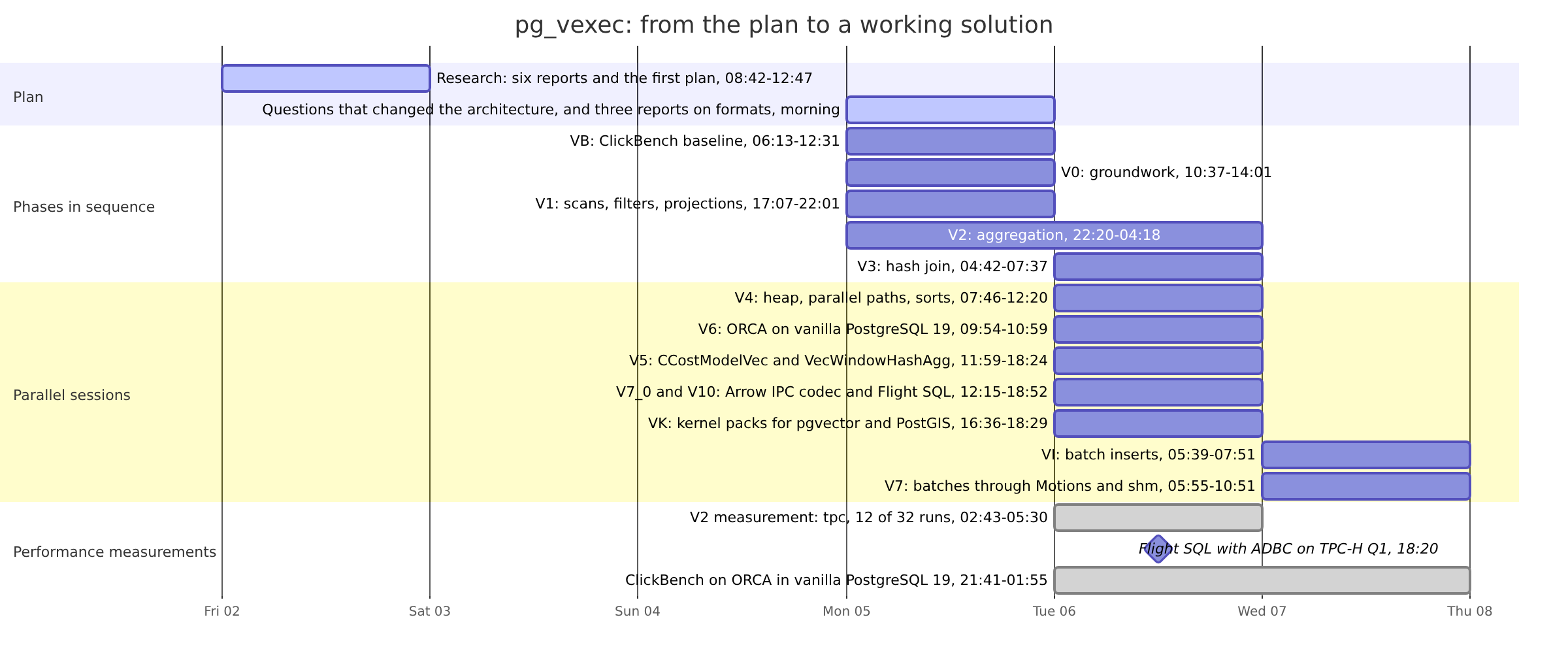
Each phase gets its own branch and its own worktree, and a commit happens only after I approve it, after which the task statuses in the plan are updated. On October 6, V4, V5, V6, VK and V10 were built by parallel sessions, while the Cloudberry port’s session took the defects they found in Cloudberry and fixed them in its own session: there were about ten, in PAX, gp_core and ORCA, plus one more in PostGIS 3.7.0rc2. The sessions take turns with the 40 GB runs: two of them side by side once hung the host.
There were surprises this time too:
- A test that passes without the fix. Since V1, the boolean register’s type had lived in the statement’s memory, and the next statement read freed memory. In a single query string the check passed, because an identical type took up the same memory, but sent as separate queries it crashed the backend every time. Now every regression check is first run without its fix.
Unknown geometry type: 2139062143. That’s 0x7F7F7F7F, a debug build’s freed memory: vexec evaluated a lazy target in the query’s memory, that is, in the functions’fn_mcxt, and PostGIS’s caches considered that memory their own. PostGIS’s own test caught it;- ORCA pruned the best plan. ORCA uses a partial plan as a lower bound for pruning, and
CCostModelVeccosted it above the plans it bounds, so ORCA threw away cheaper aggregations and join orders; - OID 7100. ORCA hard-codes Cloudberry’s hash OIDs as constants, while gp_core assigns them at installation, so a GROUP BY on a table keyed by
cdbhash_int4_opsfailed withcould not find hash function for type 23 in operator family 7100. I ran into it while implementing Arrow data transfer through Motions.
The outcome
In three days of implementation I built a vectorized query executor and planner as a PostgreSQL 19 extension that:
- runs on a vanilla server without a single core patch, ORCA included, and goes back to vanilla PostgreSQL behaviour with one setting;
- turns ORCA into a vectorized engine, on a single node just as on every segment of an MPP cluster;
- moves data in columnar form from PAX and ao_column into the executor’s memory and back without needless serialization and deserialization, and passes batches between segments as Arrow frames;
- serves and accepts data as Arrow through Flight SQL, straight from the planner’s and the storage’s data structures;
- processes PostGIS and pgvector data types with their own functions over columnar buffers in the query executor’s memory;
- behaves like PostgreSQL: 239 regression tests pass without edits to the expected files, and the TPC and ClickBench answers match DuckDB’s reference answers.
That’s about 43,000 lines of C in vexec, 7,900 in vexec_flight, a thousand in the kernel packs and about 13,600 in the Cloudberry port’s modules in pg19/, the shm transport and copies of PAX files included. Next up are further optimizations and performance measurements, and running ClickBench on columnar tables in Cloudberry. Of course the project still has room to grow and things to optimize, but even at this stage it is far more than a prototype for speeding up PostgreSQL. The result is an open-source database that integrates better with the AI/ML ecosystem by speaking Apache Arrow over Flight SQL to the outside world, while still supporting the existing PostgreSQL drivers.
In a few days of implementation I proved that vectorizing query execution in PostgreSQL doesn’t need a fork. PostgreSQL 19 already has everything needed to plan vector nodes inside the planner rather than patch plans after the planning phase. And PostgreSQL’s semantics were preserved without sacrificing query speed. ORCA, inherited from Greenplum, now plans vector nodes even on vanilla PostgreSQL, without gp_core and without a single core patch. A modular approach in an open-source database is worth far more than walling a fork off behind a high barrier to entry and the exclusivity of its maintenance. I believe that in the long run, modularity and an open ecosystem pay off more for the developer community and for those who run PostgreSQL themselves.
The results are available here: pg_vexec (vexec), pg_vexec_flight, pg_vexec_pgvector and pg_vexec_postgis; the Cloudberry port’s changes needed for vectorization are in pg19/.